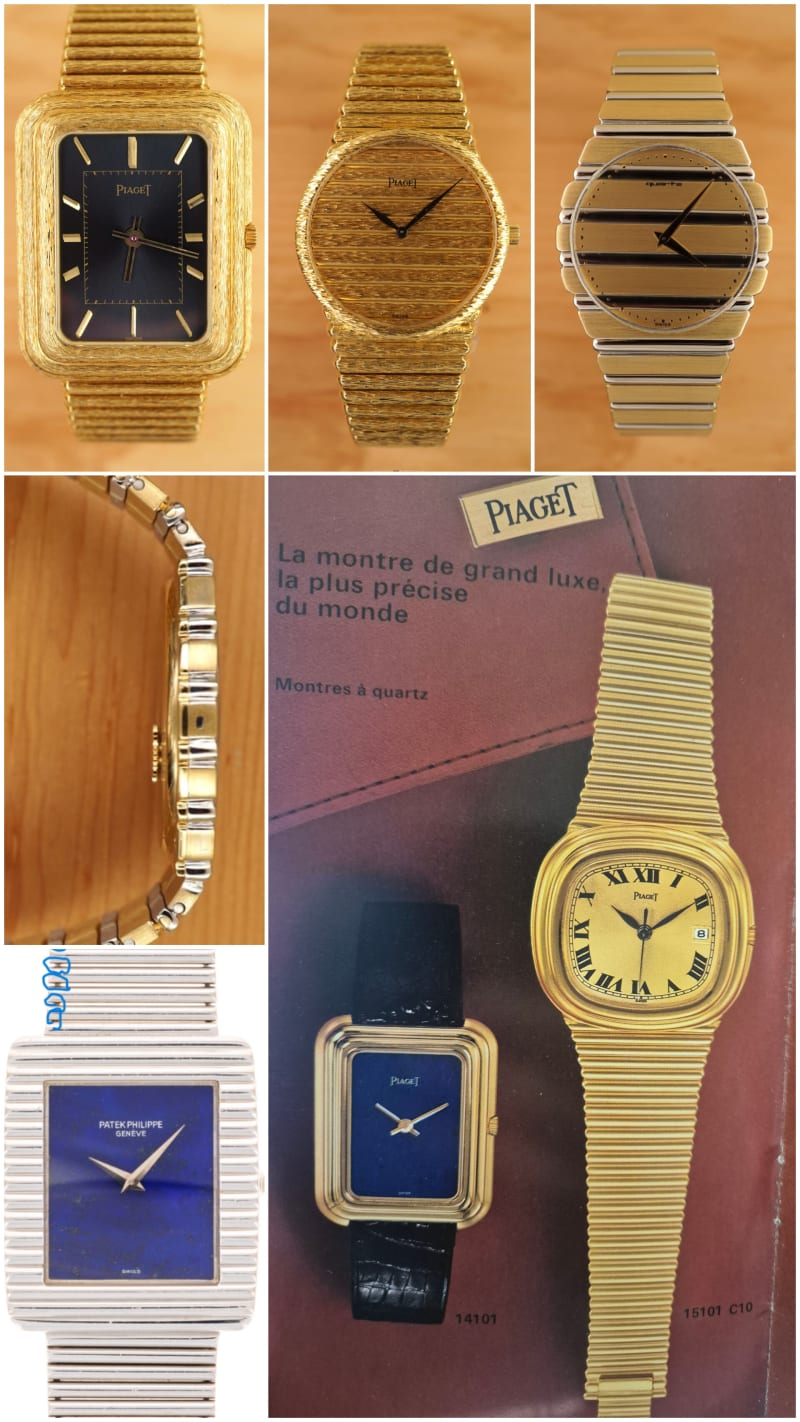
IN-SHORT: The nowadays celebrated "Gadroons" of the actual Polo79, the characteristic and separating element in the re-edition of the important 1980s-classic by Piaget, have its root probably not in a just-decorative idea but are the evolved three-stepped Beta21-cases by Piaget: ie. the "Black Tie" & "Rectangle a l'Ancienne".
The first Swiss quartz-movement Beta21, presented in April 1970 on the MusterMesse Basel (MuBa), was finished and produced in a rush: the surprising market-introduction of the Astron cal35 by Seiko on 25th of Dec 1969 put some pressure on the alliance of Swiss watchmakers to have something in store on the important fair. And so some put more effort in to their version of the Beta21 and some less. I have outlined in this blog already why I think that Patek was not as serious as many others about the new electronic technology, at least the quality of their ref3587 creates that impression. And I also mentioned that the Piaget Beta21 (ref14101 "Rectangle a l'Ancienne" and ref15101 "Black Tie" and today "Andy Warhol") is probably the one of the highest quality, next to the Rolex ref5100 "Texano" and superior to all other manufacturers.
The Piaget comes with a solid gold movement-holder and all parts -- besides the movement and the crystal -- are made of gold: no costs spared. Even more, the Black Tie ref15101 has an inside domed crystal that is flat outside and creates an amazing effect, when light comes in and plays with the impressive dial (both references were made in several dial-variants and some with stone-dials as well).
But there is more and the Piaget-Beta21 is leaving significant footprints in horology: the three-stepped case was designed by Jean-Claude Gueit (JCG), the designer in charge for everything at Piaget during their heydays in the late 60s to the late 80s. And these steps are a returning element in his works and then part of some of the most successful watches of the last century. These steps are 3mm wide and they were the reason why JCG elongated the case with the so-called Emperador-bracelet in 1971 or 1972: each 3mm-link is following the 3-stepped Beta21-case; each link is detachable and the solid and well-thought construction of a hinge-joint between the links makes it not only heavy but also a very practical and durable watch-bracelet. It has to be called an important innovation and the design has to be attributed to JCG and the execution and manufacturing of this highest art of goldsmithing was done by the artisans of Ponti Gennari, which were probably one of the most celebrated and important goldsmiths in horology and owned by and exclusive part of Piaget since the late 1960s: 'klikk.
The weight should be noted, as the first Emperador-bracelet was made in late 1971 and production and sales of this heavy bracelet (140 - 240g) accelerated in parallel (!) to the rising gold-price: from USD35 / oz in early 1971 to USD70 in 1972 and >USD180 in 1974 (five-fold the long-term price until 1971: USD35 -- *klikk).
We noted this strategy of Piaget here (*klikk) and there (*klikk), already; it was this unique strategy of handling the gold-price explosion, that lead to the name "Emperador" (King of Kings, Kaiser, Czar) -- the bracelet made it not only the most expensive watch of this time; but also the most impressive and precious. And it was singular: The Emperador-bracelet was three to four times the weight of the Rolex President-bracelet; much more robust than this and less prone to stretch. Rolex had the Kings crown; but Piaget was the Emperador.
And a word to another "King": Patek Philippe mimicked the Emperador-bracelet from 1976 for some years with its ref3733. They did so because the Emperador was not only the luxury top-end of Swiss watches in the mid 70s, but also quite a success. Fun fact: the Patek used just approx 30 - 40% of the costliest and most price-volatile ingredient for the ref3733 and the Emperador, alike: gold. Just, instead of full and solid links connected in a joint-hinge that give it a luxurious haptic feeling and a robust appearance, Patek Philippe used hollow tubes (!sic) threaded on two gold-wires (see the photo of an whitegold example). Have you ever wondered why the Piaget Emperador often comes with the signature-finishing of Ponti Gennari "Palace Decor" and the Patek ref3733 is always simply-finished with a flat polish? The "Palace Decor" is hammered and chiselled; this is possible when you use solid gold links; but when hollow tubes are used, like Patek did it to cut costs, then you better dont apply such techniques.
But the story of the Beta21-steps continues: the Emperador became a very successful watch-series on its own, either powered by the cal12P automatic or the cal9P manual or from 1977 and following by the cal7P: always a synonym for highest luxury and bold gold manufactured in a new and avant-garde way by the best of the industry: Piaget X Ponti Gennari. As discussed, the watch & bracelet-type is obviously directly connected to the Beta21 and its 3-stepped case design by JCG. But it went further: in 1979 Piaget presented the (JCG-designed) Polo, the undisputed watch of the 1980s and the reason why Piaget was top back-then and number one: *klikk. And the Polo is basically a (slightly thinner & lighter) Emperador with just every 2nd link elongated from 3mm to 6mm: *klikk. So we see not only the same designer at work for Piagets three icons (Beta21, Emperador, Polo) but also a connecting design element that has its root in the "Black Tie"-called three-step Beta21-case.
The overall idea of a watch as a luxury item that is precise but not necessarily telling the exact time to-the-second (notabene: neither the Beta21, nor the Emperador, nor the orginal Polo had a seconds-hand) is a connector of the three lines, as is the idea of of a discreet dial in the same style and finishing as the case & bracelet. The idea that Nicolas Hayek chose the same shape & dimensions of the back then most expensive & successful watch, the Polo for his comparatively cheap Swatch was mentioned here and might be the end-point of the vintage Polo history: *klikk.
Let us close with a word to the pricing of the Beta21: the Piaget was significantly costlier than the already high-priced equivalents: Patek ref3587 (USD3'500, nb: a ref2499 was priced less than USD2'200 at the same time) and the Rolex ref5100 (USD4'000). With the rectangular Piaget ref14101 priced USD4'500 and the end-point of luxury, the cushion-shaped Black-Tie (model for the nowadays-AndyWarhol-called) ref15101 being sold for USD5'500.