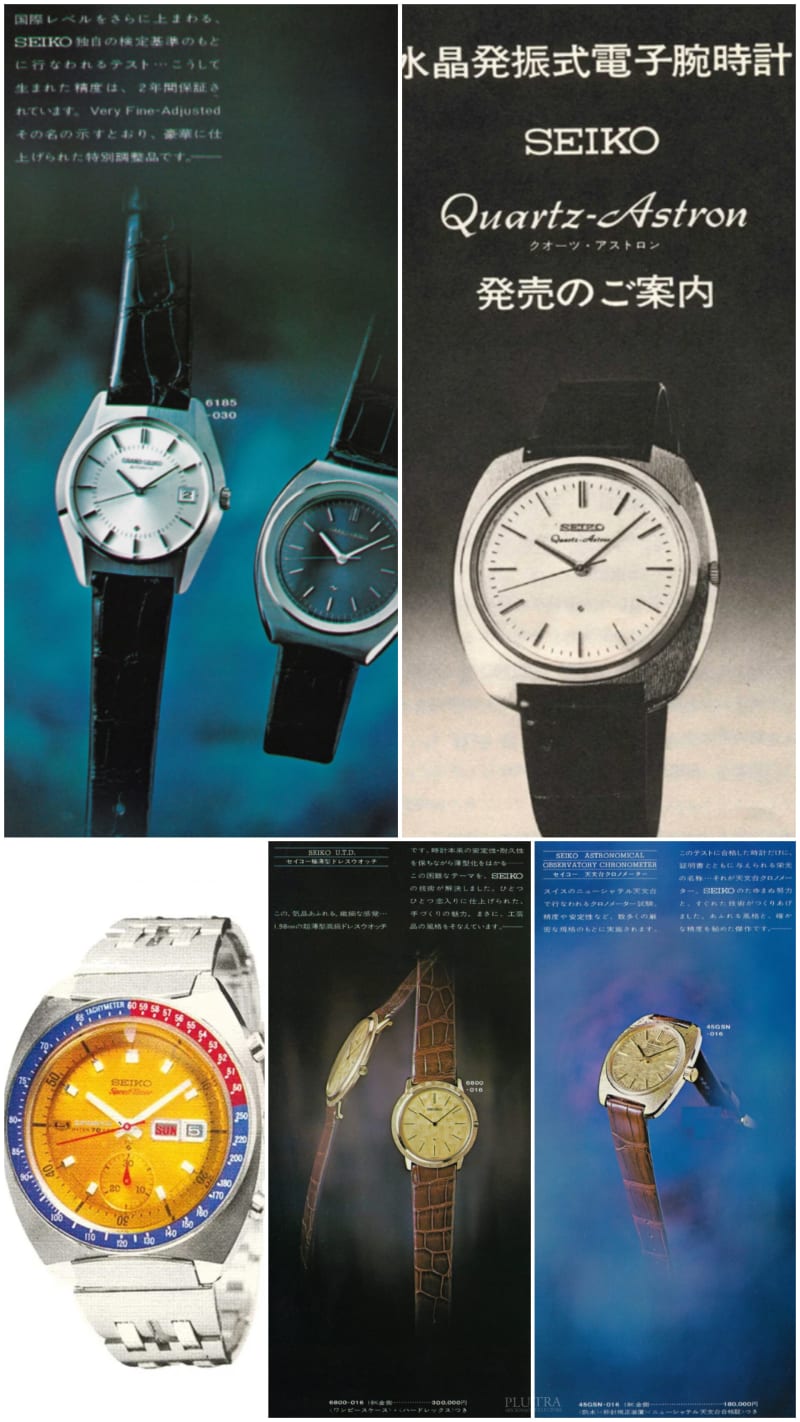
Indeed, Seiko was either first or missed it by some days and so was second to present an automatic-chronograph to the world -- the debate is hot and ongoing: either Zenith with their El-Primero or Seiko with their cal6139 was first or second. And obviously some confusion arises from the fact that sometimes the press-announcement, sometimes the prototype-presentation and sometimes the first real introduction to market is used. In my opinion this is a confusing and invalid method to use anything else but the first pieces available for sale to the public -- real market introduction. All other insights to the garages, to the development process or stories told to someone ("Press") is irrelevant and distorting.
When this objective criteria (Market Introduction) is compared then Seiko was first and Zenith second in the race toward an automatic chronograph. But my point is another: remarkably in the same year (1969) Seiko not only presented the Seiko Speedtimer Auto-Chronograph but also the UltraThin Dress (U.T.D.) with a mechanical movement cal68, thinner than 2mm and so not only a hairline thinner than the Piaget cal9P (1.99mm) but also one of the worlds thinnest movements of this era: *klikk. It is encased in an advanced monocoque-case: *klikk. Something that was never before seen in Seikos offerings and to my knowledge in all of watchmaking a first, an innovation in 18K-gold. Overall there is a lot of progress visible in Seikos art of goldsmithing in 1969 -- a catch-up to the Swiss masters of goldsmithing.
But there is more, much more. Seiko introduced the V.F.A. Standard for its cal45 (manual) and cal61 (automatic) mechanical movements in 1969: +/-2s per day, not in a laboratory but guaranteed to the customer (!) and so something that is today (!) the Rolex Superior Chronometer standard or the Omega Master Certification... (today!) In my opinion the peak of accuracy in mechanical watchmaking, reached in 1969, already. See here: *klikk. And to bring this 1969-achievement into context: Seiko dominated the Swiss Observatory Chronometry trials in 1967, which were not held in 1968ff. and its fair to note that there was nothing comparable offered by Swiss watchmakers in that era.
But back to 1969. Last but not least and for sure not to forget: just a week before this highly active year 1969 was going to end, the innovative superpower from Japan presented the world first quartzwatch Astron cal35; a real introduction to market on Dec 25th.
So we see in 1969 alone:
- a giant leap in goldsmithing with some innovative cases;
- the first Auto-Chronograph introduced to the market;
- the ultra-thin cal68: 1.98mm and 0.01mm less than the cal9P by Piaget;
- the 1st quartzwatch cal35 Seiko Astron;
- dominance in mechanical-accuracy and introduction of the ultimate and superior V.F.A. standard;
Well, the so called quartzcrisis was still far away and not even thought of in these last days of 1969 but given these achievements in a wide variety of watchmaking by the rising competition from Japan, I am wondering what would be the name of the following contraction in the Swiss watch-industry, If the quartz-watch had never been invented—or if the cost-reductions in electronics of the mid and late 1970s hadn't taken place, leaving the quartz-watch as nothing more than an expensive luxury dead-end.
NB: By the way, to compare market-introduction with a protoype or press-release is a very similar method used by Pierre-Andre Schmitt in Switzerlands most prominent newspaper NZZ regarding quartz (Beta21 vs Astron): *klikk.