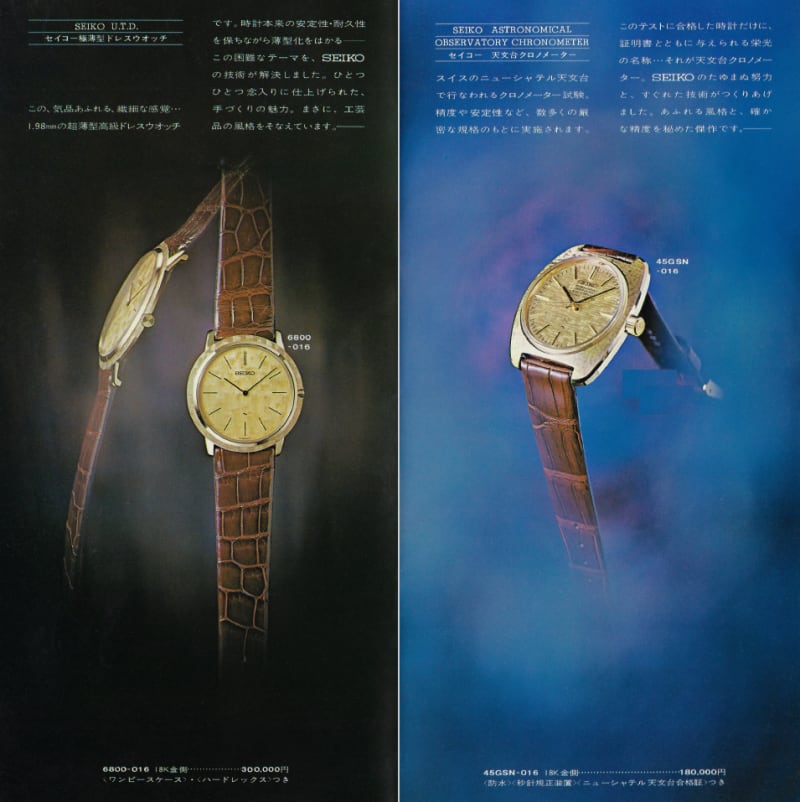
Let's compare the Seiko Astro-Obs Chrono ref4580-8020 and the (pre-Credor) Seiko U.T.D. GoldFeather++ (Ultra-Thin-Dresswatch) ref68-6000 -- see here: *klikk.
Both Seiko-watches appeared in the same year and on the same double-page of the 1969 Seiko-catalogue and both watches are testaments to the unprecedented catch-up of today's giant from the Far East; both are important artefacts of industrial-history, and both are watches of superb craftsmanship and relevance... so many similarities; but since one (the AOC) became a popular timepiece that commands prices >CHF100'000 (*klikk) the other is so overlooked, so forgotten that many experts are not even sure it really existed -- see the comments here: *klikk. And while the relevance of the AOC cannot be discussed and overestimated this is a good reason to have a look what leads to the foggy darkness around the other one -- the UTD GoldFeather++. Besides the fact it is a wonderful gold-case (monocoque!) with an outstandingly beautiful, all hand-made finishing and thus the blue-print for what became Credor in 1974 the following facts explain its invisibility:
– it was by far Seikos most expensive watch ever and more than 66% more expensive than the popular Astro-Obs-Chrono (JPY300'000 vs JPY180'000); it was double the price of the rare Palladium-made ref6185-8010 V.F.A and even 3-times as expensive as the nowadays extensively celebrated V.F.A ref4580-7000 — and so it was made and sold in much less examples than any of these: much, much (!)... much less than any V.F.A and even less than the ~230 pieces of the AOC;
– its cal68A is not only ultra-thin but also delicate; many probably broke or had issues in the last >60y;
– the watch-case is “unpopular” small and thin and it is not easy to survive as a small and thin watch when the clientele is looking for over-sized wristwatches;
– the watchmaking complication “miniaturization” is often overlooked; Chronometer & "more-precise-than" is easy to understand; but the most important complication in watchmaking -- all else is clock-making -- "Miniaturization" needs more in-depth understanding of the craftmanship and the ability to abstract; see our #ultraThin-posts: *klikk.
– on top of all that the watch-case was from 18K-gold, making it victim to smelting;
However, as the cal68 is -- after some refinement & improvement -- still produced today and housed in the finest Credors today we can call it a very important watch and a very important caliber.
So, in both watches we see two of the most important timepieces of the last century. After a decades-long catch-up of the Japanese to the Swiss watchmakers, we see the point in time (1969) when they reached the same level in the three most important aspects of the art:
- precision (Astro-Obs Chronometer)
- miniaturization (U.T.D. with cal68, a hairline thinner than the Piaget cal9P): *klikk
- case-making (monocoque UTD & screwed-caseback AOC, both in highest-level gold-cases)
The Seiko AOC & the Seiko UTD are the two artefacts demonstrating this. Remarkably, both are not Grand Seikos but even Greater Seikos; because the Greatest Seikos are not Grands.