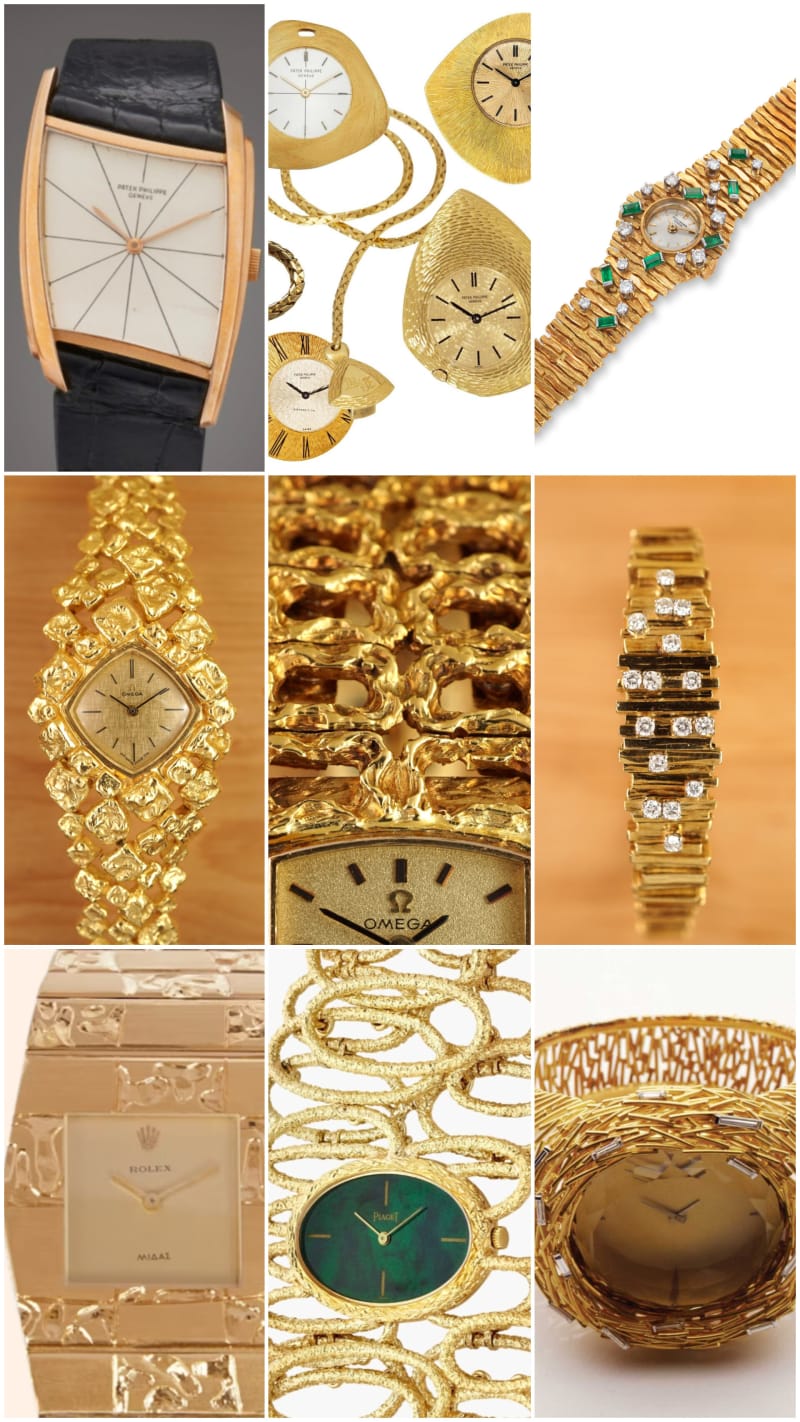
In the golden era of avant-garde horology and jewellery design -- the late 1950s through the 1970s -- one name continually surfaces as the ultimate catalyst: Gilbert Albert. The Genevan master did not simply design watches or jewelry; he treated 18k-gold like a living, breathing canvas: hot & molten gold. By rejecting traditional symmetry and embracing raw, unconventional textures, G. Albert established an entire design language that blurred the boundary between high jewellery and a kinetic sculpture. Moving, liquid gold like Dalis "The Persistence of Memory" as a decorative jewellery. This is the GA-design language that was so innovative and transcendend in the 1950s. In the 1960s he developed a second not-less innovative and new design-element: by chiseling, hammering and engraving into the object, he was further adding facets, points were light can break and reflect; he increased the complexity and depth of the object by adding further dimensions compared to flat polished jewellery.
And for the 60s and 70s these techniques, combined with the asymmetric lively shape, were his most important design elements: to create not a flat surface but adding depth and complexity. Both, naturalistic (asymmetric) shapes & naturalistic (hammered, chiseled, engraved) finishing, created objects of unseen complexity and became not only G. Alberts signature-elements but were quickly copied by other designers and shape the most attractive jewellery even until today. But obviously: he did so as the first; as a pioneer while we see iterations and evolution behind his revolution; and so his influence was immediate, profound, and continues to reverberate even among today's independent artisans.
Gilbert Alberts work for Patek Philippe from the mid 1950s had been the asymmetric but yet flat finished ref3424 and alike -- his above mentioned 1st revolutionary design-element. By the end of the 1950s and early 1960s we see the hammer- & chisel-finished creations of GA for Patek (*1) more regularly -- his 2nd revolutionary design-element. And so several iconic Patek-watches combine both of his design-revolutions: the Patek "Golf”, “Ricochet”, “Futuriste", the Patek ref3290 and the matchstick-theme of ref3289/24J to name some.
His subsequent masterpieces for Omega in the early 1960s are to be seen in this development of G. Albert and combine both signature designs from the beginning and in any watch. Even more: the innovation called "Gold-Link", a 3rd idea of Gilbert Albert, was introduced and allowed the adjustment of the bracelet length without to be seen or recognized after adding or reducing the length. No surprise, these innovative timepieces completely shattered the conservative and classic watch- & jewellery-design. His trademark-series Rocaille d'Or, Mailles d'Or and Jeux d'Or -- defined by organic, bark-like open goldwork -- influenced all of the scene, paved roads that were not existent until then and set trends that glow until today.
Andrew Grima, the legendary British jeweller, and his celebrated "About Time" collection for Omega in 1969 owes its entire structural DNA to the organic paths cleared by Albert. Grima’s use of textured gold stalks and brutalist crystalline frames was heavily inspired by the raw, irregular yet harmonious gold finishes that Albert had mastered earlier at the beginning of the decade.
John Donald & Arthur King: Across London and New York, these designers championed the "textured gold" movement, incorporating baroque pearls and rough-hewn gold boundaries that closely matched Albert's personal ethos: preferring the beautiful and unique over the standard and interchangeable.
Same for the French pioneer of architectural jewelry. Jean Vendome: he ran parallel to Albert, leaning into mineral clusters and geometric asymmetries. Vendome's work reflects Albert's core conviction -- that a piece of jewelry should be approach-treated with the gravity of a fine-art painting.
The influence of obviously one of the most important jewellery-designers of the 20th century goes even further: the Jean-Claude Gueit-designs for Piaget, especially the opulent ladies cuffwatches (eg. ref9467D59 etc) almost all speak the same language. Not static but living decorations in naturalistic design and shape, further faceted by the depth-providing finishing techniques perfected by the artisans of Ponti Gennari (part of Piaget since late 1960s) and now called "Palace Decor" in their actual creations. Even the "Gold-Link" technique found its way into the opulent creations by JCGueit and Piaget.
And Gilbert Alberts legacy reaches out to current jewellery designers: Patcharavipa deforms originally symmetric watches to make the gold-object more lively and naturalistic (asymmetric) and further adds depth, facets and dimensions by using finishing methods resulting in naturalistic surfaces (chiseled, hammered etc), in the tradition of Gilbert Albert: *klikk.
What we see in the products of G. Albert and the GA-influenced designers: Rather characteristic, individual, unique and situational manufactured jewellery than products designed by a team, produced in masses as a design willing to compromise and to be mass-compatible. And this stream is eventually not the most profitable, given the machine-made competition but still alive and timeless.
--
*1) even the ref3422 appears with hammered flanks in 1963 and so combines his two revolutionary design-elements in one mens wristwatch by Patek: *here;