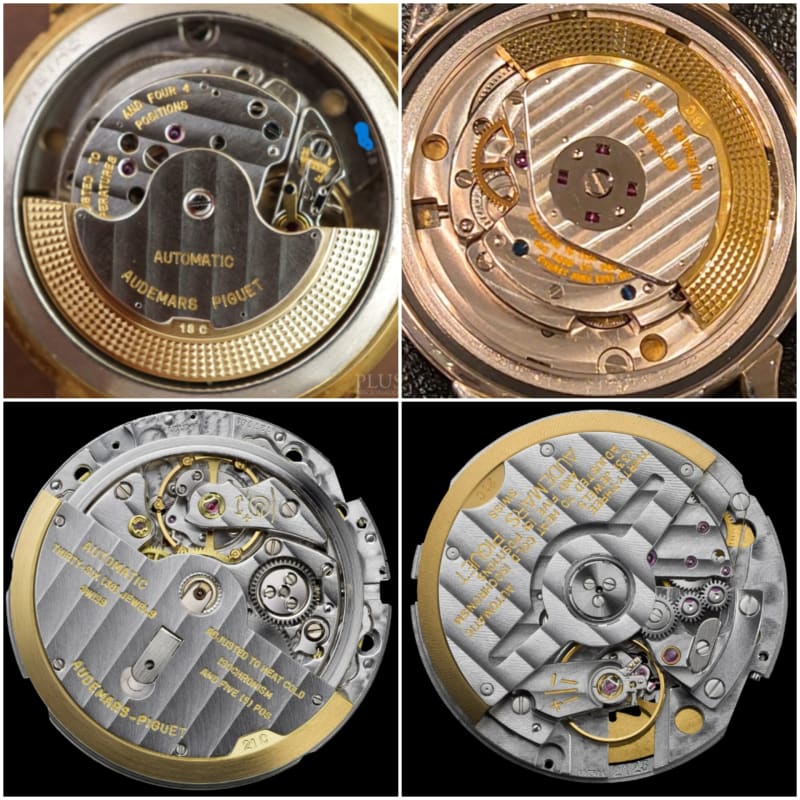
Preamble: There is a tremendous value in the historical relevant early Audemars- & Vacheron-automatics -- these are not only horological-important and manufactured (ie hand-made!) in highest quality, but they are also in magnitudes rarer than the usual and quite common VC cal1120 aka AP cal2120 (based on the JLC-ebauche cal920) and later automatic-movements, that appeared in rather large quantities from 1970 onwards. This is not only obvious on the secondary market, but something that we can see in other movement-types as well and something that we will try to explain at the end of this article.
For now, let us have a look at the four relevant generations of AP automatic-movements and their important differences and approx production numbers .
Manual-wound pendulum-movements (mechanical-movements with a balance) are around for centuries and so it doesnt left one in surprise that the first important innovation, the "automatic"-winding took the world of watches by storm and was in strong demand throughout all manufacturers. But the brisk monopolization of the rotor-automatic by Rolex in 1932 excluded all other manufacturers from the production of something "perpetual" until 1952 (exceptions here: *klikk) -- something that is still noticeable until today and cemented the reputation of the Perpetual-Crown. But in the early '50s they all started right away: Patek cal12-600AT, VC cal499, AP2499 etc. To make a long story short: These automatic-movements came out quite close to perfect, because the wait-period of 20y (Rolex-patent) allowed conscientious work instead of rushed market launches. And so the main improvement in the following decades (!sic) was the reduction of friction of the winding-rotor...
Top Left: 1954, Audemars first Automat, the cal2499 (cal2498 is the same with small-second instead of center-second) is based on a JLC-ebauche (JLC cal499) and comes with a beautiful guilloche-finished 18K-gold rotor-mass; the rotor sitting on a steel-steel-bearing -- basically the worst you can think off in terms of fritiction; but nevertheless probably the rarest and most important AP-automatic and something that makes a noticeable and characteristic and wonderful noise during the winding -- so overall a fair compensation for some friction. The movement is based on a JLC-ebauche and Vacheron used the same, called cal499. *Klikk here for the VC-automatics. So how many were made of this initial footstep in the automatic-realm? Of the cal2498 AP made in maximum 490pcs; of the cal2498 in maximum 700pcs made at all; but I assume significantly less than these almost 1'200 (combined) and would not be surprised if the total numbers are below 400 in sum of cal2498 & cal2499. Why? The same era and best-comparable 1st automatic by Patek Philippe, the cal12-600AT used in the Patek ref2526 was made in 600 - 800pcs in the same time. It is the technical equivalent of similar horological importance. But the number of Patek ref2526 that we see on the market is by far higher than the number of AP cal2498 and cal2499 combined; again: by far.
Top Right: The 2nd generation of automatics used by AP (1955ff) is probably the most iconic and characteristic automatic-winding movement ever used by Audemars Piguet & Vacheron Constantin and eventually at all: the AP cal2071 / cal2072 or cal1071 / cal1072 as VC calls them. The guilloche-decoration on the rotor-mass is now something that found followers and is still applied by AP and now by VC as well. And next to this obvious decoration there are four ruby-rolls visible around the center of the winding-mass: the bearing of this rotor and less frictional and more beautiful than the earlier steam-punk-bearing in the AP cal2499. It seems like in maximum 1'940 watches powered by this movement were made, but as with the 1st generation-movement already: I assume much less and would not be surprised about around just 1'000 examples shared between the cal2070, cal2071 and cal2072.
Bottom Left: We can see here the 3rd generation of the AP- & VC-automatic movements -- again based on a Jaeger-ebauche, the JLC cal920: the AP cal2020 (aka VC cal1020) introduced in 1967. Running on a center bearing with support by ruby on rails at the perimeter of the rotor (which create the characteristic sound) it is a super-thin beautiful automatic that made its large footprints in horology over decades (AP Royal Oak ref5402, PP Nautilus ref3700 and many more) and became a classic and a workhorse alike: with more then 50'000 watches powered by this movement it is far from being special -- if not specially engraved, used in a very-limited edition or skeletonized to rarify the common. In total maximum 23'000 pieces of this movement were made in its first 7 years until 1975. But here as well: we assume that the actual production numbers are less than that, although not just half but probably 80% of these maximum-number. However, the cal2120 & cal2121 were in production much longer than just 1975 and over its total lifespan it could be assumed that actually >70'000 of this classic were made. So, by these production-numbers it is not rare but a commodity and so openwork / skeletons as well as calendar-modules were necessary to create niches and collectibles that attract interest -- something that comes to the early auto-generations in a very natural way.
Bottom Right: The first AP-automat with a rotor using a highly efficient ball-bearing to translate as much power as possible to the mainspring-winding instead of overcoming frictions in any other bearing appeared with the AP cal2123 (1977, based on the JLC cal900) and there was a reason: Eterna secured the patent for the ballbearing by their EternaMatic & used it proudly as the 5-balls-logo from 1948 onwards until 1968 (20y patent-period in Switzerland).
NB: Rolex adapted this superior low-friction-bearing a little later (2015) in their cal3255 (2015) and Vacheron Constantin did so a bit earlier with the use of the VC cal1096 (based on the JLC cal906) since 1973 -- their Chronometre Royal: one of the rarest and probably the best (ie. most efficient) automatic used by VC -- but Audemars did not use this movement. I guess the reason for this divergence could be found in the fact that AP went into electronics by co-financing the MegaQuartz-project with Omega (AP cal2510 MegaQuartz, 1974) at this time, while Vacheron did not and completely set on a superior mechanical movement, instead.
Photo-Source: own & Audemars Piguet (*klikk)