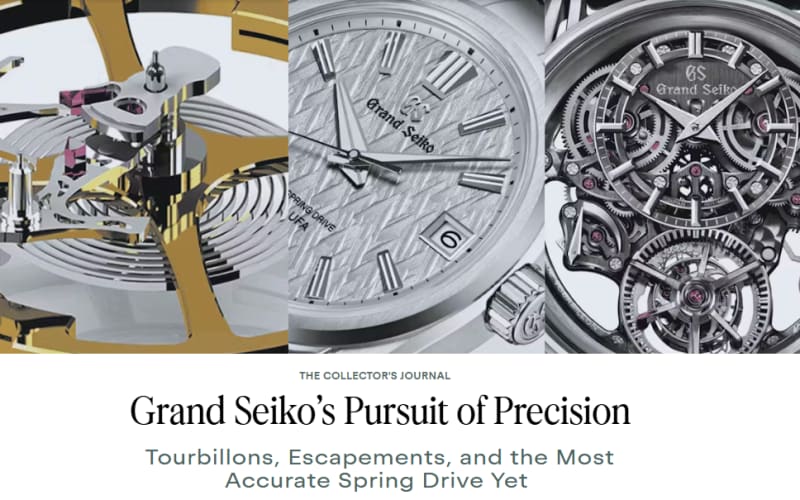
Jack Forster discusses "Grand Seikos Pursuit of Precision" (here: *klikk) and it is an impressive tour-de-force with the giant from Japan demonstrating excellence in almost any part of watchmaking plus opening up completely new territories with amazing innovations: mechanical, electronic & in between (kybernetik). Spontaneously one question came to my mind: Which Swiss company is still in this race toward perfect precision? Did everyone left in Oct-1960, when Bulova presented the Accutron, the first electronic watch (*klikk)?
And I am very serious. By changing the selling-point from something rational, objective and measurable -- precision -- to something emotional, fluid and even spiritual ("the ghosts I summoned: the soul of a watch;" *klikk) the race to precision was left, just like the Neuchatel Chronometer-competition: abandoned & closed in 1967.
Technically, in mechanical watches the peak was reached more than 50y ago with the Grand Seiko V.F.A.-standard (variance of 5 seconds per day (spd)) in 1970; something that Rolex applies with their Superlative Chronometer-standard (also a var of 5spd) since 2015 as well. The Omega Master Certification guarantees the same variance and the hololy trinity (Audemars, Vacheron & Patek) stands above all these earthly constraints and "applies their own measures". OK, nice. Just, we dont see progress in this category since more than five decades and so the assumption that the endpoint in the precision of mechanical movements was reached long ago, is valid: especially in a real world-environment (ie. not laboratory) and guarantee-able. Since then we see catch-up processes and shifts from -2/+2 to -1/+3 and back to -2/+2 again, but nothing new and improving.
But not completely: Citizen announced a variance of 2 seconds... per year (spy). Impossible in mechanics but achieved by using electronics (quartz). And Seiko has presented the SpringDrive UFA with a variance of 6 seconds per month (spm) bridging both technologies -- mechanics & electronics -- and creating a market in between the two realms in all aspects: technological, philosophical and in terms of precision.
Realizing that these are obviously Japanese companies, I want to repeat the question for Swiss watchbrands with a different taste: Is it possible that it was a major strategic mistake to dogmatically exclude everything besides mechanical movements and instead focus on innovative movement decoration-techniques? And if so: What could be done to change this trajectory?
Photo: the1916company.com