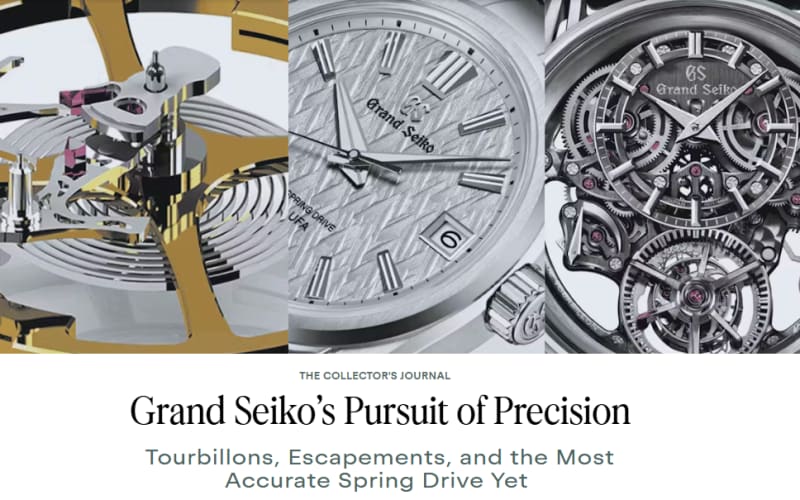
Jack Forster discusses "Grand Seikos Pursuit of Precision" (here: *klikk) and it is an impressive tour-de-force with the giant from Japan demonstrating excellence in almost any part of watchmaking plus opening up completely new territories with amazing innovations: mechanical, electronic & in between (kybernetik). Spontaneously one question came to my mind: Which Swiss company is still in this race toward perfect precision? Did everyone left in Oct-1960, when Bulova presented the Accutron, the first electronic watch (*klikk)?
And I am very serious. By changing the selling-point from something rational, objective and measurable -- precision -- to something emotional, fluid and even spiritual ("the ghosts I summoned: the soul of a watch;" *klikk) the race to precision was left, just like the Neuchatel Chronometer-competition: abandoned & closed in 1967.
Technically, in mechanical watches the peak was reached more than 50y ago with the Grand Seiko V.F.A.-standard (variance of 5 seconds per day (spd)) in 1970; something that Rolex applies with their Superlative Chronometer-standard (also a var of 5spd) since 2015 as well. The Omega Master Certification guarantees the same variance and the hololy trinity (Audemars, Vacheron & Patek) stands above all these earthly constraints and "applies their own measures". OK, nice. Just, we dont see progress in this category since more than five decades and so the assumption that the endpoint in the precision of mechanical movements was reached long ago, is valid: especially in a real world-environment (ie. not laboratory) and guarantee-able. Since then we see catch-up processes and shifts from -2/+2 to -1/+3 and back to -2/+2 again, but nothing new and improving.
But not completely: Citizen announced a variance of 2 seconds... per year (spy). Impossible in mechanics but achieved by using electronics (quartz). And Seiko has presented the SpringDrive UFA with a variance of 6 seconds per month (spm) bridging both technologies -- mechanics & electronics -- and creating a market in between the two realms in all aspects: technological, philosophical and in terms of precision.
Realizing that these are obviously Japanese companies, I want to repeat the question for Swiss watchbrands with a different taste: Is it possible that it was a major strategic mistake to narrowing the possibilities and dogmatically exclude everything besides mechanical movements and instead focus on innovative movement decoration-techniques? And if so: What could be done to change this trajectory?
Photo: the1916company.com
Ad 2026-04-03: In 2020 Accutron had become a independent brand and in 2026 they published an updated but overall quite similar version of the vintage tuningfork Bulova Accutron cal214 -- now named Accutron cal314 but running with the same finely audible rate of 360Hz -- and the spicey note: Accutron & Bulova are completely owned by... Citizen. So the frequency of 360Hz is also in Japanese hands, leaving 3 and 4Hz to Switzerland -- for a telephone-provider, that would be the end.
Overall the article is a bit pointed but I think it is still possible to change the future-path, innovate in this area and change the overall attitude. Just do it! Wait, this slogan is also already occupied. Hopp Schwiiz!
Ad 2026-05-21: Man kommt unweigerlich zur Frage, ob sich eine ganze Industrie mit Iterationen von Design und Werksfinissierung wirklich weiter-entwickeln kann; dh. über den Status Quo hinaus, Plus Ultra. Wenn daran Zweifel bestehen, dann sollte man die aktuelle Hoch-Zeit nutzen, um ernsthafte Änderungen am Alleinstellungsmerkmal (Unique Selling Proposition) vorzunehmen. Ein paar Ideen hätte ich dazu schon; ob mal jemand fragt? Schau'n mer ma', dann seh'n mer scho'.
Ad 2026-07-25: Two further aspects that were mentioned in this blog before and show the problem from another angle: I expected that Rolex will present something really innovative in March 2025 (see here: *klikk), as they issued promising clips and texts: engineering tomorrows watches, today. But it was a fail. Instead of something future-proof like SpringDrive (the patents have expired in 2020), it is still a pendulum (a mobile pendulum: balance) called DynaPulse; a further iteration and complication of a technology that is stagnant since 1970.
Interestingly, it was Piaget (the only watchbrand that created all used parts completely in-house since the 1970s and was quite active in research of all kinds of movements: cal9P, cal12P, cal7P etc) that presented the cal700P in 2016: a mechnical-movement corrected by a quartz-reference. That is basically the idea born by Longines with their Ultra-Quartz and that Seiko made a working future-proof core-technology of its offerings: SpringDrive. And one can guess that Piaget invested quite some time and resources in the research of that cal700P but what did they do? They made just 188 pieces in a limited edition and closed that chapter... Well, I am not in charge but I cannot think that these 188 pcs returned the investment in total. Even more, this technology is obviously one that allows for optimization and development for the next decades (ie. future-proof) but you make it a limited edition...
See our Japanese masterpieces, overall very interesting and important watches, for sale here: *klikk