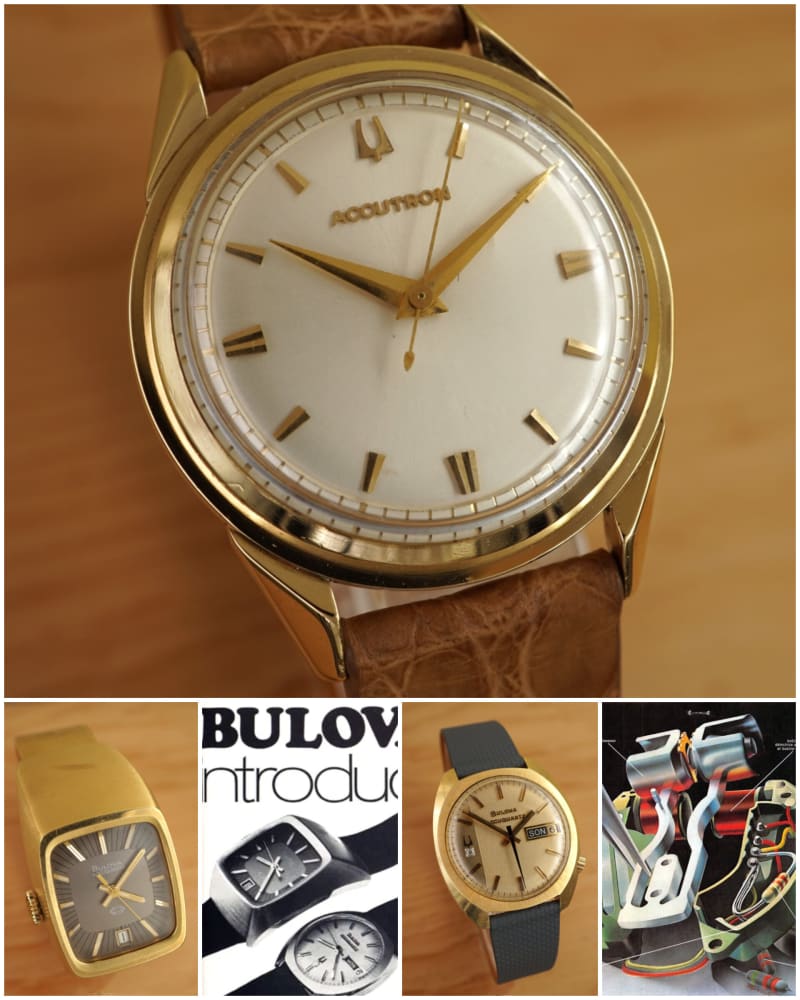
The USA-Swiss company Bulova was once becoming a giant; one of the most important (and economically biggest) watch-companies in the 1960s after disrupting the fully mechanic Swiss watchindustry and opening the Space-Age with the Accutron cal214 (top, literally one of the first: a 1960-example in 18K) -- the first electronic watch. Invented by a Swiss engineer, Max Hetzel, it was the timekeeping heartpiece of more than 30 NASA missions and was orbited more often than any other watch in the 1960s -- it was the Bulova Accutron that brought Omegas "MoonWatch" to the moon.
Bulova was also part of the Centre Horology Electronique (C.E.H.) with the intention of developing the 1st quartzwatch. And although the Japanese were first by 5 months (Seiko Astron: 1969-Dec 25th) Bulova and the partners of the Swiss joint-venture (Rolex, Omega, Patek, Piaget, IWC, Zenith, Elgin, JLC, Rado, Bucherer etc) well succeeded with the legendary Beta21-movement -- another horological MileStone -- encased in the most futuristic and heaviest of all the variants by Bulova in their "AlienHead" on a Jean-Pierre Ecoffey-bracelet (bottom-left, also one of the first, made in 1970).
And it was this switch to quartz-technology that heralded the decline of Bulova in the 1970s. But not without setting what is for then a final milestone in 1972: the AccuQuartz cal224, the first US-quartzwatch (bottom-middle, again an early 18K-example from 1972).
These days Citizen Watches took over the Accutron-brand and re-introduced the tuningfork-technology with a modern vibe as the Accutron cal314 -- a niche today, for sure. But an interesting one and a unusual, vibrant and electronic way to measure time; but back then avant-garde and a revolution that fell victim to an even more advanced & disruptive technology: quartz.