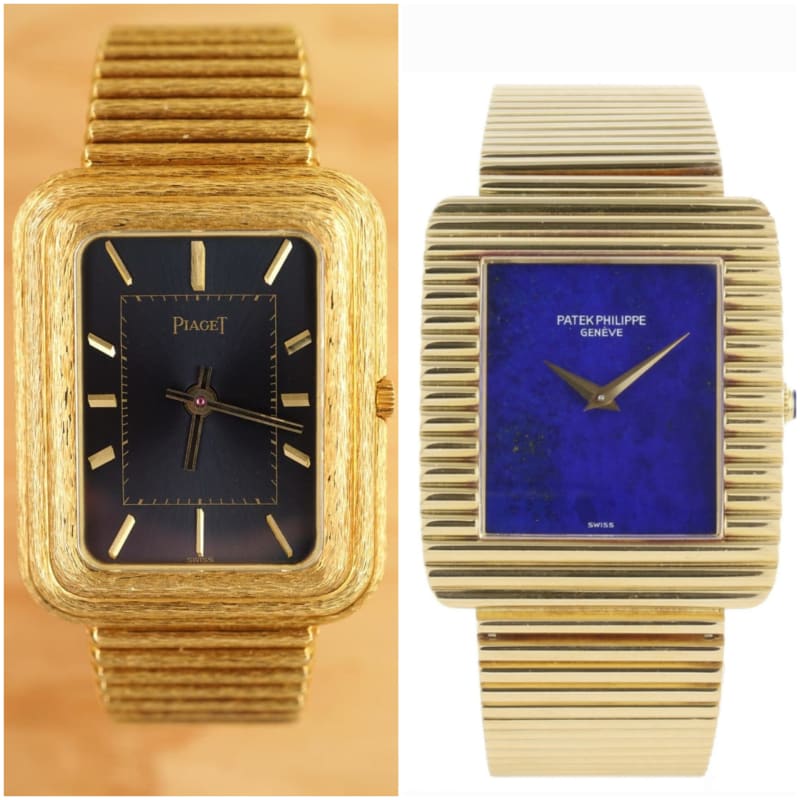
Let us compare the Patek Gondolo ref3733 (made since 1975) vs the Piaget Emperador (made since 1972) -- I guarantee surprising insights to horological-history. Both watches were characteristic and time-dependent icons of the mid- to late-1970s. An era when Piaget set the tone -- not only: they also set the trend for stonedials, which they artfully created since the mid-1960s exclusively. Exclusively because they were until the mid-70s the only brand that was able to make these stonedials: cut stones in thin slices of 0.7mm, drill a hole into the middle and polish them -- that was possible by Piaget but with a high rejection rate.
The Patek Philippe ref3733 was now one of the first watches of Patek with a stonedial and they were proud obviously -- and they could, it is a beauty, indeed. But then the traditional brand from Geneva went only half way -- like Patek sometimes does, when you look exactly (*klikk): they tried to mimic the back then undisputed top-dog; the single most outstanding watch-model of the 1970s; the Piaget Emperador.
But while Piaget, the House of Gold (*klikk) made it solid, heavy and no costs spared, Patek shied away from making it right, making it costly and making it expensive and instead produced hollow empty tubes (!sic), which were threaded onto two wires... Really! You cannot think of something like that and especially next to each other the Patek comes in like the Potemkin village of an Emperador. It is the same category like a jeans-print on a calfskin-strap (*klikk), a masterpiece of authenticity... But what could go wrong when everyone is sure and and ensures everyone else that Patek is the greatest and always will be, right!?
*Ad 2026-02-23 * The success of the Emperador paved the way for the 1979-presented Piaget Polo. The dimensions of the round Emperador ref12336 and the round Jumbo Polo ref7661 are the same but while the Emperador is significantly heavier the Polo has every 2nd link elongated to 6mm instead of 3mm -- the interlinks are exactly the same. Same for the the rectangular Emperador 9131 and the rectangular Polo 7131 -- same dimensions but every 2nd link elongated to 6mm in the Polo.
*Ad 2026-02-24 * You know why the Piaget Emperador often comes around in a breath-taking all-handmade finishing -- sometimes flat-polished but often hammered or chiselled (Piaget calls it Palace Decor) -- while the Patek ref3733 is always (always!) flat-polished, only? Well, different than on the solid Piaget hammering or chiselling the hollow empty tubes of the Patek would not improve the overall appearance.
*Ad 2026-02-25 * Now, when you take into account the availability of the 3733, which was obviously made and sold in multiples of the comparable Piaget Emperador and when you then see its much higher price, then you see the inefficiency of the market: emotional-driven hunting for a single brand in a herd sometimes leads to an inferior and overpriced item.
*Ad 2026-03-16 * What becomes clear now: the Piaget Beta21 ref14101 or ref15101, with the three-stepped case was the beginning of the Emperador-line: and the Emperador was THE dominant watch in the 1970s; the predecessor of and model for the Piaget Polo; the most expensive & lavish piece and the model for this Potemkin-Patek ref3733.