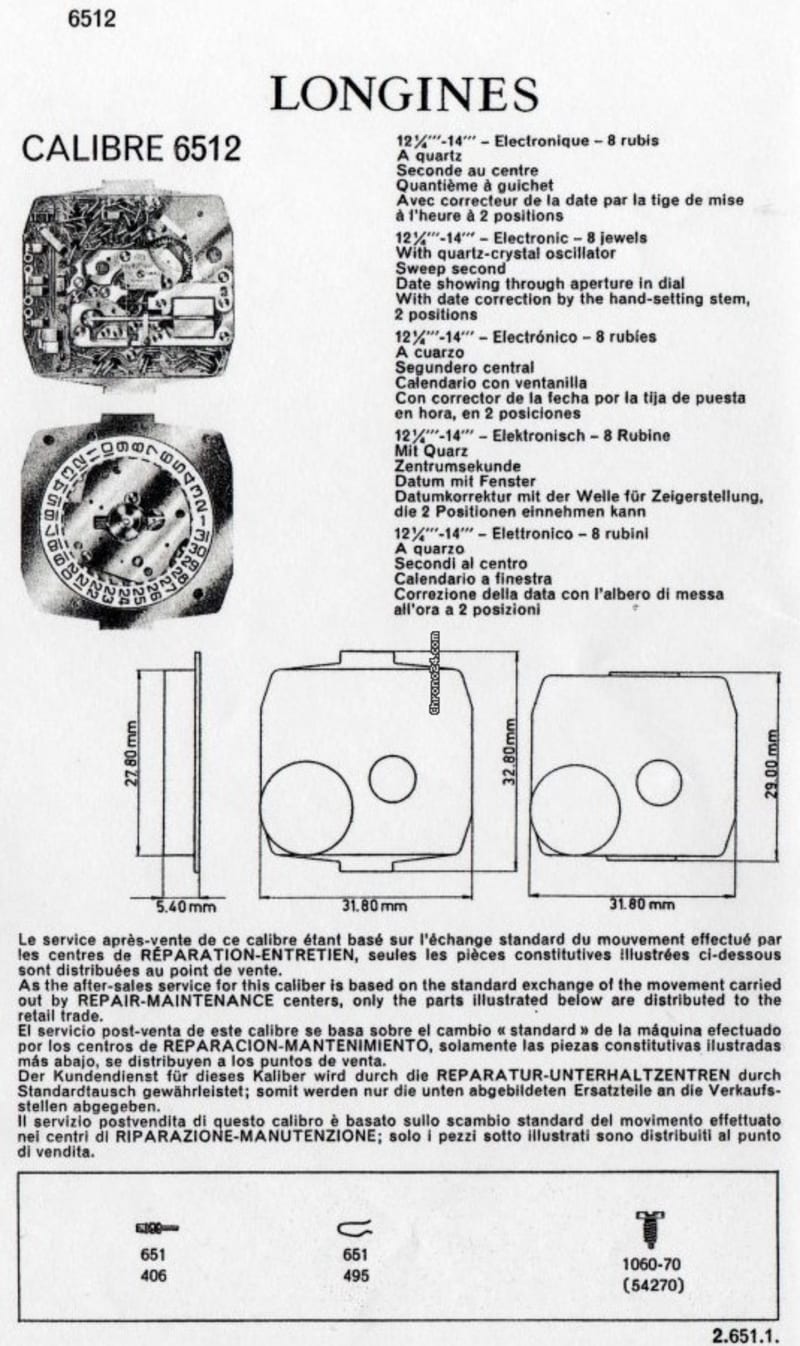
Longines developed its UltraQuartz movement cal6512 in parallel to the Beta21 development and their early success -- they announced this innovation in August 1969, although sale and public offering started later and slowly, as everything was assembled by hand -- made Longines to pull out of the CEH Beta21 project: they sold the majority of their project shares to Omega and produced finally just a fraction of their initially planned Longines Beta21 QuartzChron cal6412.
However, the cal6512 UltraQuartz used a similar but fundamentally different concept at all: a tuningfork-like micromotor humming at 170Hz, which was used to make the hands move, was the timer and it is checked in a feedback-loop regularly against a quartz vibrating at 9'350Hz. So, basically a "conventional" watch -- exactly that was a tuningfork-movement in the 1960s -- that is regularly checked and adjusted against a high-precision quartz. Sounds familiar for the Seiko SpringDrive enthusiasts and it is exactly that: the Longines SpringDrive of the late '60s. Visionary and inspiring.
That means, the differences to Beta21 is the fact the quartz was just used as some kind of correction against the micromotor and not as the source of stable intervals to move the motor. And furthermore it used discrete electronic components instead of a integrated circuit: that resulted in a wild arrangement of 14 transistors, 19 resistors and 7 capacitors on the main plate -- all assembled by hand.
So, while we have Beta21 being the earliest quartz-driven Swiss wristwatches, the Longines UltraQuartz cal6512 was the first publicly announced watch, that made use of quartz -- beating even the Seiko Astron 35SQ by four months. However, its prototype appearance, its time consuming and complicated assembly and its unreliability make it probably the rarest of the pioneering triumvirate: Longines UltraQuartz, Seiko Astron 35SQ and CEH Beta21.
*Ad 2025-02-17: * The kybernetik (ie. feedback loop) interaction between a conventional watch & quartz-timer was an idea so far ahead of its time and technological feasibility, that it took Seiko under the lead of Yoshikazu Akahane until end of the 1990s to realize a marketable version.